GROUP THERAPY

How is group therapy different from individual therapy?
It’s more affordable.
Group therapy is advantageous in that the client gets more perspectives and feedback than from only the therapist. In a healthy group participants witness others working through issues and get the chance to contribute to healing by listening compassionately and learning the art of providing constructive feedback.
Group members learn from seeing others work.
More people = more transferences = emotionally rich environment = ability to work on, express and tolerate strong emotions in oneself and in others.
The therapist can see their patient in a social environment rather than relying on the patient’s self accounts.
Confidentaility: Most groups have a set of guidelines they ask each member to respect. Members do not share any personal or identifying information about other group members. They can share about their own experiences or about the leader, but not about each other. We ask that if participants share anything with each other outside the group that they bring that back to the group to contain the emotional experience inside the group.
What actually happens in a process group?
The therapist usually screens all members in individual sessions for appropriateness of fit and to prepare each member to use the group. Group members are instructed to check in with themselves moment by moment and take note of their feelings, thoughts, and associations in reaction to what is happening in group or toward other group members. There is usually a focus on the "here and now" as well as issues each group member is having in their lives. Leaders rarely introduce topics but help the group form trust and share openly. As group members gain trust and interact more freely with each other, they use and recreate the same relational patterns and styles that have hindered them in their lives. In a healthy group, members can receive feedback on how they come across and the impact they have on others, which gives them valuable information about how they relate and are perceived. Then group members can choose to work on their relational style in the group and practice to do it with other people in their lives.
Group Space for Practitioners
The Positive Mind Center also offers larger rooms for practitioners who wish to facilitate group therapy, workshops, process groups, or other wellness offerings within our supportive and professional community setting.
Currently Active
Men’s Group: Emotional Depth, Intimacy, and Connection
Facilitator:
Andrew John Tucker, LCSW, CASAC-G
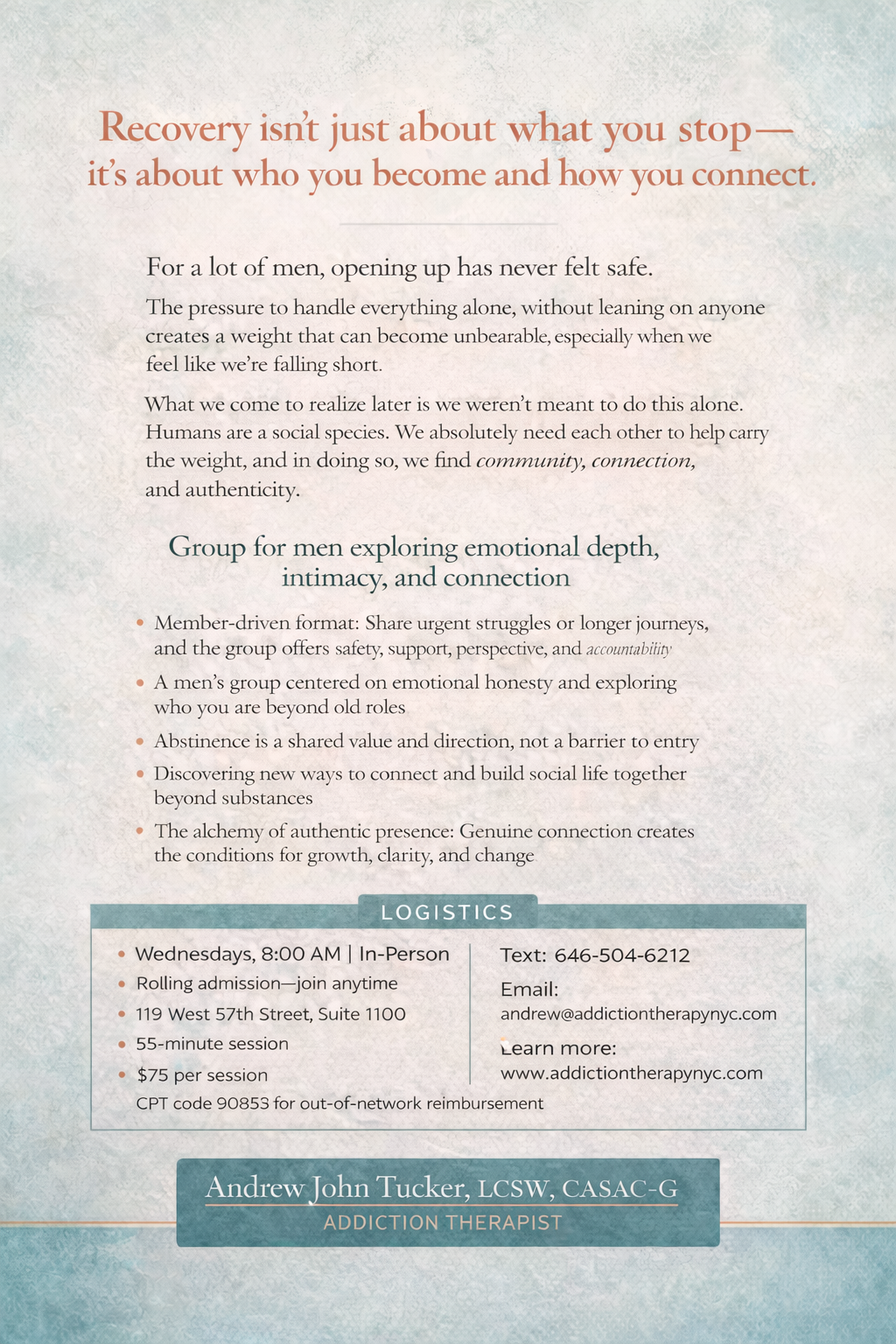
If you are interested in joining or want to learn more, reach out:
Text: 646-504-6212
Email: andrew@addictiontherapynyc.com